
I read an essay by a writer of memoir, who expounded on her momentous decision to tell her story through fiction, rather than memoir. I thought her clever, and then I blinked, as a faint whisper sounded from the back of my brain: “Isn’t that what novelists do?”
I stared out the window for sometime, thinking of it. I realized that the writer of the essay had managed to sound immensely authoritative, as if rediscovering the wheel, but she had simply put forth what novelists have done since the beginning of novels.
Take Agatha Christie. Of course she didn’t murder people, but she lived much the life of her characters inhabiting the world of Miss Marple, and that earlier of her Tommy and Tuppence. Their views were much of her own, the countrysides, the towns, places Christie herself inhabited. In his magical Greentown series of books, master Sci-Fi author Ray Bradbury calls forth memories of 1928 Waukegan, where he was born. He remembers being a child again on summer nights, a boy running, things he felt and characters who grew in his mind from those times.
We novelists take in life all around us from birth and mix it up, as in making a savory stew, add a pinch of this here, cut the amount there, make this bit stronger, and get an entirely new idea and character from this little point here.
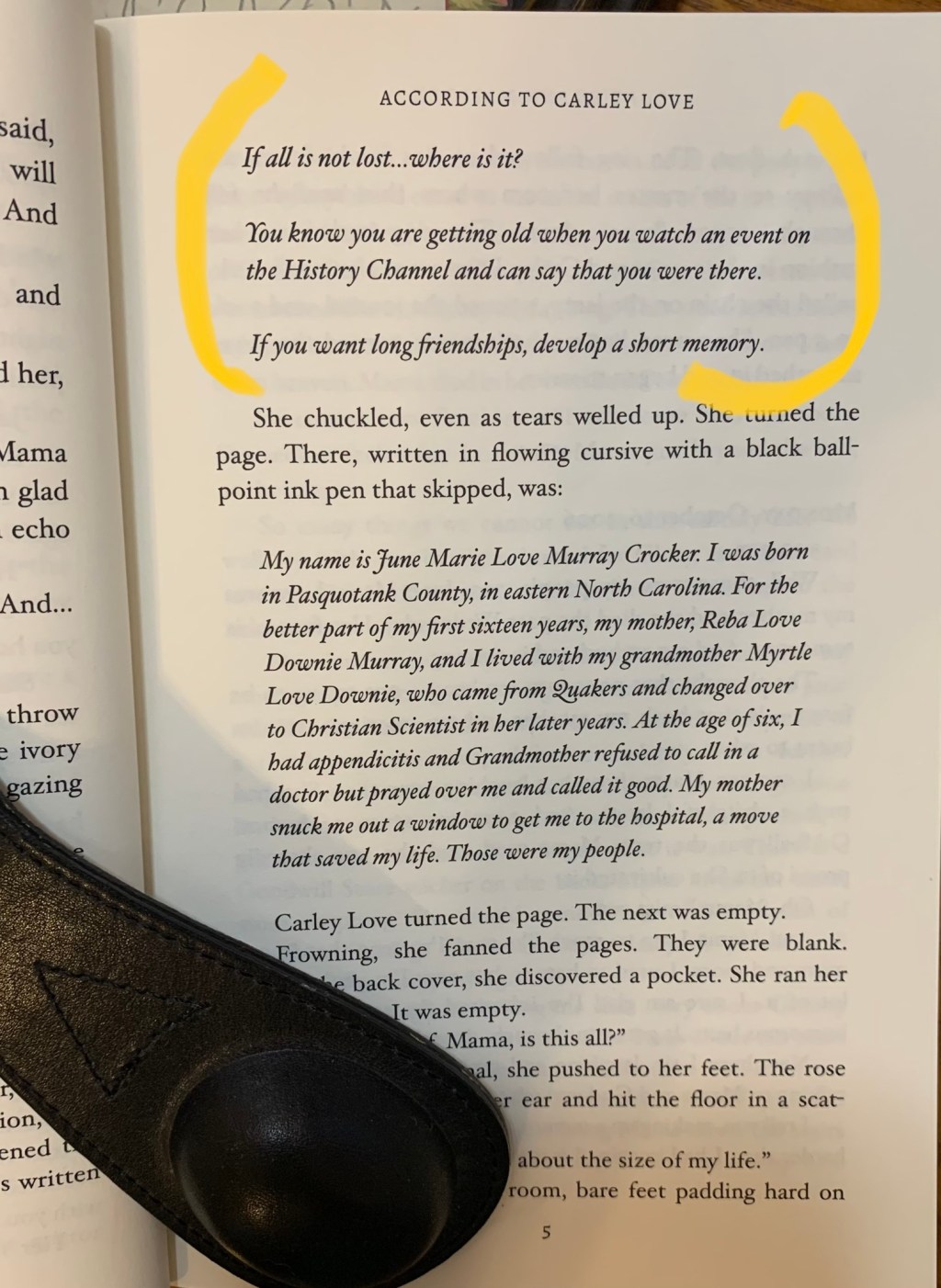
In the opening pages of According to Carley Love, my heroine finds a journal that belonged to her mother. She reads three quotes written there–pictured above. I took those quotes directly from a three-ring plastic binder I found in my mother’s things after her death, where she had recorded quotes and pithy sayings that struck her. Some she had typed, others she had written by hand, all saved over years and years. Yes, my mother loved to laugh and read, and she loved her thrift store shopping, too.
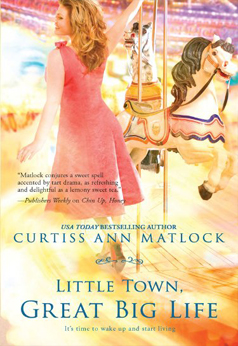
When I recently read the opening pages of the final book in the Valentine series, Little Town, Great Big Life, I remembered the town of Valentine and how I created it because it was a place I would like to go–and other readers say the same–“If only we could go live in Valentine!” The drugstore was a compilation of such drug and sundry stores of my youth, and Winston Valentine’s radio show was created from memories of the radio station in my parents’ hometown when I was a child. We would travel to visit my grandmother, and I remember listening to the small plastic radio sitting on a table beside the rocker with swan arms, to the farm report, and to the social program that reported who had been doing what, and to the bingo program, which you played by getting cards from the local grocery store.
We make all this stuff up, but it has its beginnings from memoir.
In the words of the great writing teacher Dwight Swain: “The first real rule of successful story-writing is…find a feeling.”
You find those feelings from within memory of things you’ve experienced. You weave in things that have happened to you and things you wish would happen and things you imagine happening to characters. Pretty soon there is no way to tell what is real and what is fact, and that is why your stories are believable.
In writing this post, I’m led to see that my idea of writing the story of my family is going to have to be much fiction. I am incapable of writing plain fact. I always have to embellish. I am a novelist, after all.

| Available in eBook and Print Buy on Amazon Buy on B&N Buy on Apple | Available in eBook Buy on Amazon |
Grace and peace,
 Curtiss Ann Matlock
10 responses to “How Much is Fiction, or Memoir?”
I tried that in 7 of my stories and it was cathartic!
LikeLiked by 1 person
Ah yes, here in France they call it autofiction, certainly in memoir two people experiencing the same event can see it from very different perspectives and if we bring back dialogue from the past, it is inevitably not going to be exactly how it might have been said. Sometimes while writing about past events, I think, why not just let go of trying to make it accurate and give oneself the freedom to stretch it. Indeed fiction does do just that. Thought provoking post.
LikeLiked by 1 person
This makes me think of how much I incorporate the small towns in the Midwest where I grew up and where I was born into my novels. The names of the towns are fictional, but the features of each are drawn from my memories or trips back as an adult to see how some have decayed. It’s hard to be anonymous in a small town where everyone seems to know (or think they know) everyone else’s business.
LikeLiked by 1 person
I will need those plates u told me about from you to put on your new books, for Nova, Gayle, and Nancy. Alex will help me order your books for Christmas gifts. I’d like for you to autograph for… 1. Nova,( neighbor in my “old neighborhood” we still try to get together once a month still.) 2. Gayle,(another neighbor from my “old neighbor”! She, Nova and I try to go out to lunch once a month!) 3. Nancy, (my dear sister-in-law, She and husband Tommy Williamson have been my dear friends since I married/ divorced the Williamson family!) Hope the above makes sense, if not call and I’ll “try” to explain🤔😂🙄 Love you CurtissAnn❤️
Sent from my iPad
>
LikeLiked by 1 person
Dear cousin, I will call you! I love you!
LikeLike
Interesting post!
I don’t believe in objectivity of writers. Even just by choosing a topic or a genre of your novel, you already tell something about yourself – what things matter to you. Following that line, eventually all choices you make in crafting your book will speak about your personal story and values, therefore, even if the narrative voice is seemingly distant, it’s very present and noticeable. Exploring that further, the line between a memoir and fiction is thin. Of course, not in technical terms, but still…
LikeLiked by 1 person
Love that word “embellish”!
LikeLiked by 1 person
I can hardly tell any story without embellishing. 🙂
LikeLike
A wonderful post!
LikeLiked by 1 person
Thank you, Liz. It is a miracle how the stories come together.
LikeLike